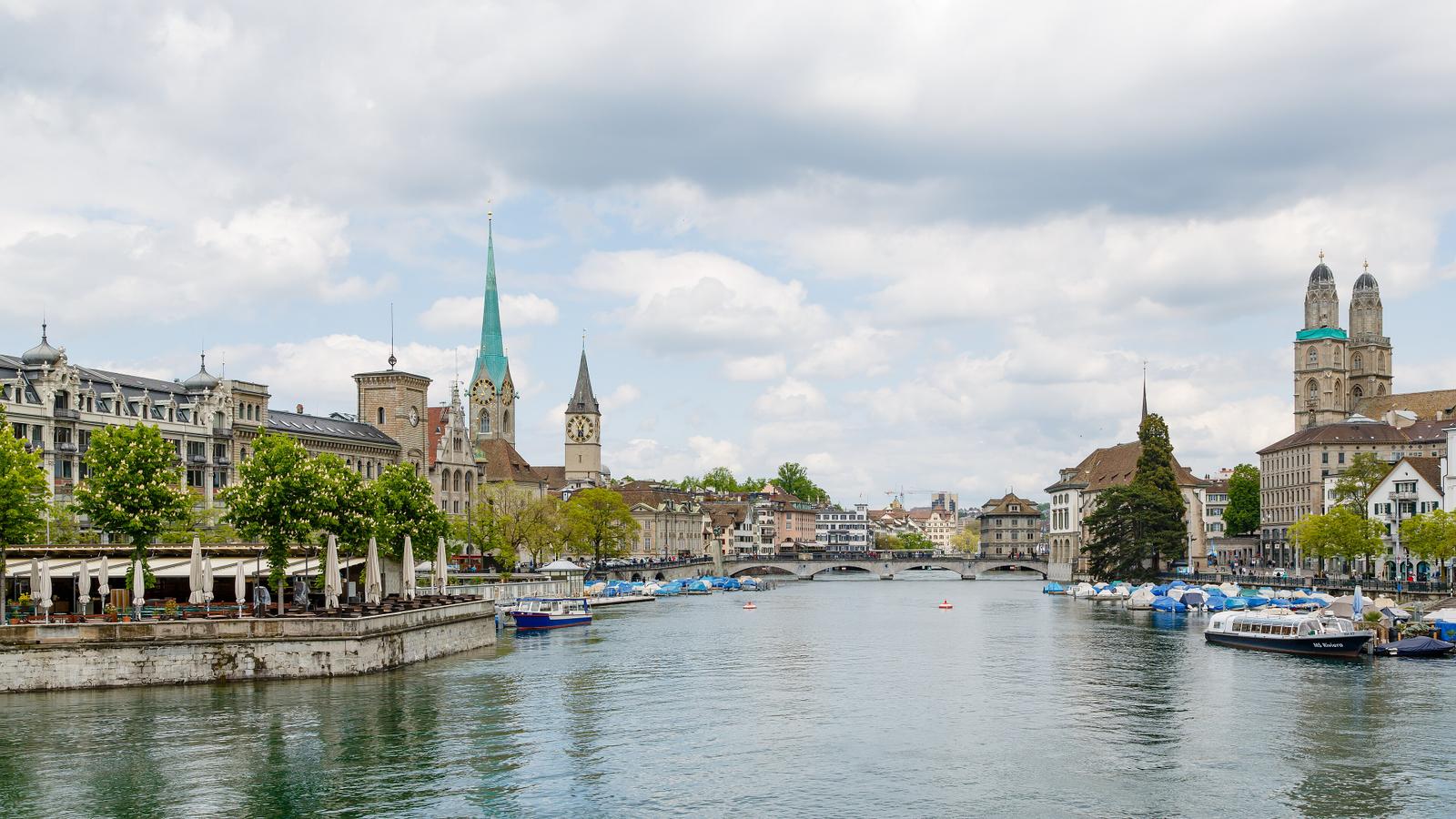
Zurich sits where the Limmat river flows out of Lake Zurich. With 436,551 residents (as of 31 December 2024), it is Switzerland's largest city, though not its capital: that title belongs to Bern. The Roman customs post of Turicum grew into a free imperial city in the Middle Ages and joined the Swiss Confederacy in 1351. Today the city debates interest rates by day and swims in the Limmat by evening: Zurich ranks, alongside Bern and Basel, among the cities with the world's highest quality of life, and an equally high cost of living. This page starts from the public baths, markets, museums and dates that actually shape the city's calendar.
From Turicum to a global city
The city's roots sit on the Limmat, where the Romans ran the customs post of Turicum. Through the Middle Ages that settlement grew into a town that gained free imperial city status in 1262 and joined the Swiss Confederacy in 1351. The Zurich Reformation began at the Grossmünster in 1519, when Huldrych Zwingli was appointed parish priest there: he preached against the sale of indulgences, the veneration of saints and mercenary service, laying the ground for the city's reformed church. Despite a comparatively modest population, Zurich counts today among the world's global cities and remains Switzerland's leading centre for media and the creative industries.
Arriving and getting your bearings
The main station, known to locals simply as the HB, handles around 3,000 train movements a day across 26 platforms and is Switzerland's busiest railway station. From Zurich Airport, trains reach the HB in about 15 minutes, several times an hour. From Bahnhofplatz, Bahnhofstrasse runs dead straight down to Lake Zurich, lined with banks and shops: it is the natural starting point for the old town, the lake, and trams to every district.
On the water: the Limmat and Lake Zurich
Zurich is a city built on water, and every summer bridge makes that obvious. The Flussbad Oberer Letten river bath offers a 400-metre swimming channel in the Limmat with a two-metre diving tower, plus beach volleyball courts and a boules area on the opposite bank; entry is free. For something calmer, Seebad Enge on the left shore turns into a sauna in winter, or a little further along, Seebad Mythenquai has a 250-metre sand beach, the only one of its kind in the city, with an outpost of the vegetarian restaurant Hiltl. The city publishes daily water temperatures and how busy its summer baths are on its website.
The old town and its two minsters
On the Limmat's right bank stand the twin towers of the Grossmünster, a Romanesque church built between 1100 and 1220. Since January 2025 the church has been partly scaffolded for a multi-year renovation but stays open throughout; entry to the church is free, while climbing the 187 steps of the Karlsturm costs CHF 5 for adults and CHF 2 for young people and students. Facing it on the left bank is the Fraumünster, with the five chancel windows Marc Chagall created in the 1970s, a rose window in the transept, and the older north windows by Augusto Giacometti; admission costs CHF 5, and the church is open March to October, Monday to Saturday, 10am to 6pm. A combined ticket for both towers costs CHF 8 instead of CHF 10.
Museums: from Swiss history to Munch
The Swiss National Museum in Zurich, right next to the main station, is the country's most-visited museum of cultural history, housed in a historicist building from 1898 alongside an extension completed in 2016. It runs six permanent exhibitions and around eight temporary ones a year, open Tuesday to Sunday 10am to 5pm, Thursdays until 7pm; admission costs CHF 13, CHF 10 concession, and is free for children and teenagers up to 16. The Kunsthaus Zürich on Heimplatz holds the largest Munch collection outside Norway alongside works by Picasso, van Gogh and sculptures by Alberto Giacometti, complemented since 2021 by architect David Chipperfield's light-filled extension. It is open Tuesday, Wednesday and Friday to Sunday 10am to 6pm, Thursdays until 8pm, closed Mondays; admission to the collection costs CHF 24, CHF 17 concession, and students pay just CHF 10 on Thursday evenings between 6 and 8pm.
Markets and shops with character
On Saturdays from May to October, the Stadthausanlage near Bürkliplatz turns into Zurich's biggest and best-known flea market: over 230 stalls of antiques, vintage clothing, books and vinyl, open 7am to 5pm, free entry. In the old town, from March to November, the Rosenhof-Markt fills a Niederdorf courtyard every Saturday with a calmer, more unconventional market, 10am to 6pm. For shopping, head to the 36 arches of the railway viaduct built in 1894 in Zurich West, known as Im Viadukt: 500 metres of delicatessens, studios and fashion labels, centred on a market hall where around 20 regional producers sell food Monday to Saturday, 9am to 8pm.
Up the local mountain: the Uetliberg
Zurich's local mountain is the Uetliberg, 871 metres high and reachable in about 20 minutes on the S10 train from platforms 21/22 at the main station; the train runs every half hour on weekdays, every 10 minutes at peak times. From the 72-metre viewing platform by the Uto Kulm hotel, the view stretches to the Alps on a clear day; the tower costs CHF 2 to enter. The Planetenweg trail follows the ridge to Felsenegg in about two hours, laying out the solar system to scale along the way, is stroller-friendly, and ends at a panoramic restaurant with a cable car down to Adliswil. Because of works on the underground station, the line between Zurich HB and Selnau is closed from 29 April to 18 October 2026, so the S10 runs only as far as Selnau during that period; SBB and ZVV recommend tram or bus for the final stretch.
For families: the zoo on the Zürichberg
Up on the Zürichberg sits Zoo Zürich, home to around 360 animal species, from the Kaeng Krachan elephant park to the Lewa savanna with white rhinos and giraffes, to the Masoala rainforest with geckos, parrots and tortoises. From March to October the zoo is open daily 9am to 6pm, the Masoala rainforest 10am to 6pm; adult admission (age 18+) costs CHF 31 through the online ticket shop, and entry is free for children up to age 6. An interactive app shows the zoo map along with the day's feeding times and animal presentations. Walking the rainforest's experience trails off the main paths requires a guide; the zoo's volunteer team runs free walks every Saturday morning.
After dark
Once the sun goes down, the city's centre of gravity shifts. Langstrasse links districts 4 and 5 and counts as the city's real party strip: nowhere else in Zurich do so many different crowds mix, with venues ranging from an after-work beer to a basement club. In the Viadukt quarter in Zurich West, Bogen F, a café-bar with a cultural and club atmosphere set under one of the historic arches, offers a counterpoint to the delicatessens of daytime. For the old town's lanes after dark, the Niederdorf has quieter spots with courtyard terraces.
Festivals through the year
Frequently asked questions
Is Zurich the capital of Switzerland?
No. Zurich is Switzerland's largest city, but the capital is Bern, the seat of government since 1848.
How do I get from Zurich Airport into the city centre?
Trains reach the main station from the airport in about 15 minutes, several times an hour. More here.
Where can I swim in Zurich in summer?
For free, right in the city centre, at the Flussbad Oberer Letten river bath in the Limmat. On the lake, Seebad Enge and Seebad Mythenquai with its sand beach are popular too.
How much does the Swiss National Museum cost?
CHF 13 for adults, CHF 10 concession, free for children and teenagers up to 16.
When is the flea market in Zurich?
The Bürkliplatz flea market runs May to October, Saturdays 7am to 5pm. The Rosenhof-Markt in the Niederdorf runs March to November, Saturdays 10am to 6pm.
When does the Böögg burn at Sechseläuten?
In 2026, Sechseläuten falls on Monday, 20 April, and the Böögg is burned on Sechseläutenplatz starting at 6pm.
How high is the Uetliberg and how do I get there?
The Uetliberg is 871 metres high and reachable via the S10 train from the main station in about 20 minutes. Due to construction works, the train runs only as far as Selnau until 18 October 2026.