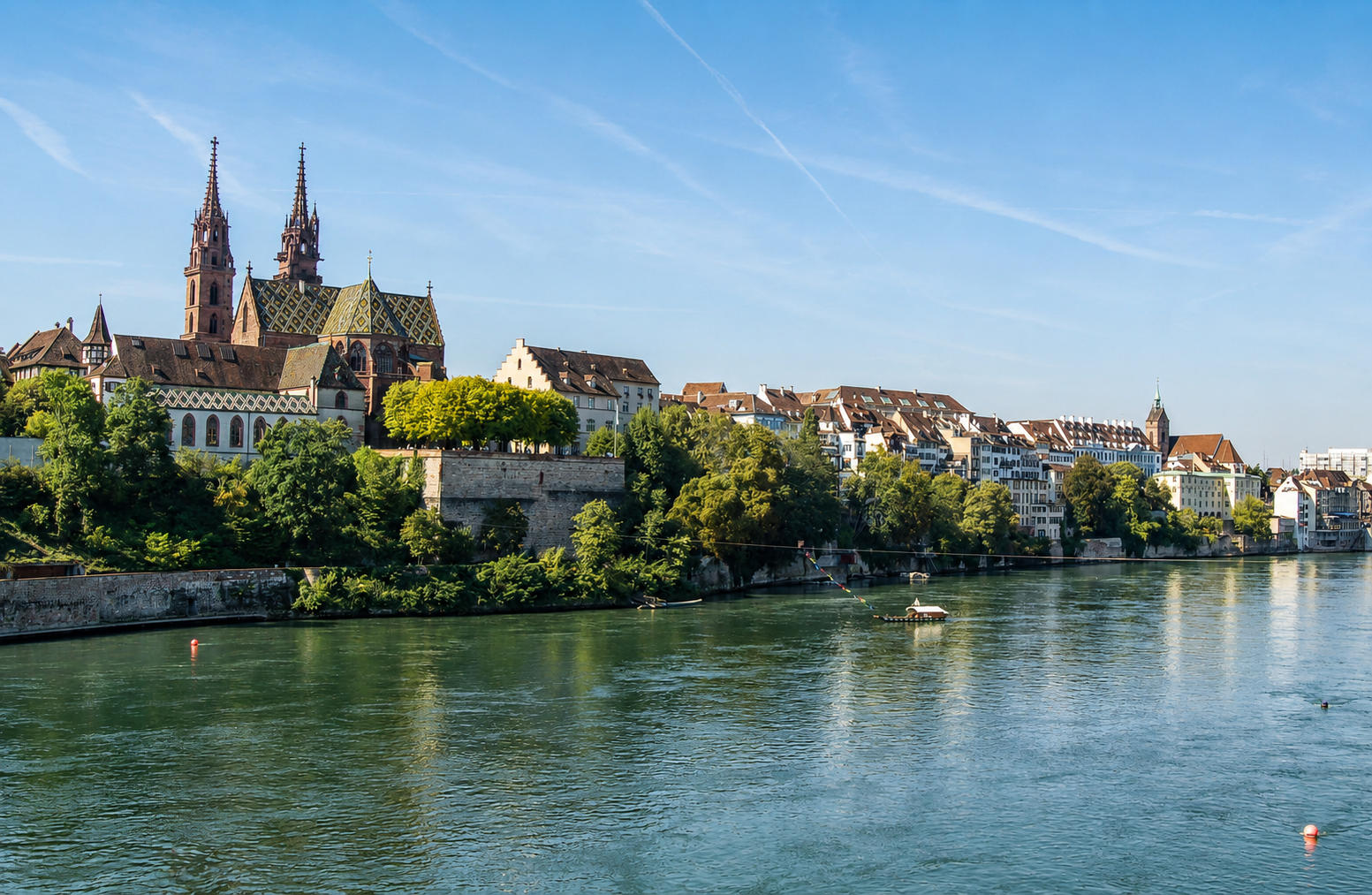
Basel sits where the Rhine touches the German and French borders. With 177,571 residents (as of 31 December 2024), it is Switzerland's third largest city after Zurich and Geneva, and internationally it is mostly known for its museums. Stop there and you miss the other half: the «Zolli» zoo, the Markthalle food hall by the station, the autumn fair and Carnival, with around 18,000 active participants. This piece covers both sides, with prices, dates and how to get there.
From council city to Switzerland's oldest university
The hill around Basel Minster has been settled since the Bronze Age. The current building goes back to construction that began in 1019. Between 1431 and 1448 the city hosted the Council of Basel, one of the major church assemblies of the Middle Ages, drawing scholars from across Europe. Those connections led in 1460 to the founding of the University of Basel, still the oldest in Switzerland today. In 1501 Basel joined the Swiss Confederacy. That long scholarly tradition partly explains today's reputation as a museum city: almost 40 museums are now spread across the canton.
Getting there and getting oriented
Basel has three railway stations. Basel SBB, opened in 1854 and rebuilt in 1907, is one of Europe's busiest international border stations and also houses the French section, Bâle SNCF, at platforms 30 to 35. Basel Badischer Bahnhof, about two kilometres away on the right bank of the Rhine, is operated by Germany's Deutsche Bahn. EuroAirport Basel-Mulhouse-Freiburg sits on French soil but is jointly run with Switzerland, which is why it carries three IATA codes: BSL, MLH and EAP. The airport has no station of its own, but bus line 50 runs directly to Basel SBB every 7 to 10 minutes between 4:30am and midnight.
Zoo Basel
Zoo Basel opened on 3 July 1874, making it Switzerland's oldest zoo. Locals affectionately call it the «Zolli». It is open 365 days a year, with hours that vary by season. A single ticket costs between 10 and 22 francs depending on age, with the voluntary conservation franc already included. The main entrance sits just outside the city centre, right on a tram line.
Basel Carnival: the «three best days»
Basel's Fasnacht carnival lasts exactly 72 hours, beginning on the Monday after Ash Wednesday at 4am sharp with the Morgestraich: every light in the old town goes out, leaving only hand painted lanterns, as costumed groups (Cliquen) march through the lanes playing piccolo and drum. In 2027 the Morgestraich falls on Monday, 15 February, and the closing Ändstraich, also at 4am, on Thursday, 18 February. Around 18,000 active participants wear costume and mask (Larve); during the Cortège parade on Monday and Wednesday afternoons, every traditional formation marches through the city. Since 2017 Basel's Fasnacht has been on UNESCO's list of intangible cultural heritage.
The Basel Autumn Fair
With more than 550 years of tradition, Basel's Herbstmesse is Switzerland's largest funfair. In 2026 it runs from 24 October to 10 November, spread across seven locations in the city centre, from Barfüsserplatz to the Minster. The craft and specialty market on Petersplatz, the Hääfelimäärt, stays open two days longer than the rest of the fair, daily from 11am to 8pm. Specialties include the Chäsbängel, a baguette filled with fondue cheese, and the sweet Mässmogge. By tradition, someone rings the Martin's Church bell on the Saturday before 30 October at exactly noon to open the fair.
The Markthalle and weekly markets
The Markthalle Basel was built in 1929 under engineer Adolf Goenner and architect Hans Ryhiner, and served as a wholesale market until 2004. Since 2013/2014 it has returned to something close to its original purpose, now with around 25 food stalls instead of wholesale trade, under one of Switzerland's earliest exposed concrete domes. It sits a few minutes' walk from Basel SBB station. Opening hours are Monday 9am to 10pm, Tuesday to Thursday 9am to midnight, Friday and Saturday 9am to 2am, and Sunday 9am to 10pm, with individual stalls and shops keeping their own hours. Once a month an indoor flea market runs there on a weekend.
The Rhine and swimming
In summer, swimming in the Rhine is something of a national sport in Basel. Anyone joining in packs clothes and valuables into a «Wickelfisch», a waterproof, fish shaped swim bag invented in Basel and sold, among other places, at the tourist information office. Strong swimmers drift with the current between Wettstein Bridge and Johanniter Bridge; a popular entry point is near Museum Tinguely. Two river baths round out the offer: Rheinbad St. Johann, open since 1887, and Rheinbad Breite, open since 1898, both running from May to September with paid showers and changing rooms. One key rule: swim in pairs at minimum, never alone, and stay clear of bridge pillars because of dangerous currents.
Museums
Museum Tinguely, designed by Ticino architect Mario Botta right on the Rhine, holds the largest collection of Jean Tinguely's work. It is open Tuesday to Sunday, 11am to 6pm, until 9pm on Thursdays, closed Mondays. Adults pay 18 francs, students 12, and entry is free for under 16s as well as during the «long Thursday» window from 6pm to 9pm. In Riehen, easily reached by tram, sits the Fondation Beyeler, open Monday, Tuesday, Thursday to Sunday from 10am to 6pm, Wednesdays until 8pm. Then there is Kunstmuseum Basel, spread across three buildings with roughly 10,000 square metres of exhibition space in total.
Sport: the «Joggeli» and the ice rink
St. Jakob-Park, known to locals as the «Joggeli», is Switzerland's largest football stadium with 38,512 seats and home to FC Basel. It was built by Herzog & de Meuron and opened in 2001. Right next to it, within the same St. Jakob sports complex, stands St. Jakob-Arena, home of ice hockey club EHC Basel, with room for 6,612 spectators. Both venues are reachable directly by tram and bus.
Family and kids
For families, the Robi-Spielaktionen association runs several adventure playgrounds on behalf of the city, including, since 2002, the covered SpielFeld playground in Gundeldingerfeld. Three toy libraries (Ludotheken) around town lend out toys and games. The Basler Ferienpass offers children and teenagers discounted leisure and creative activities during the summer holidays. Several museums also cater specifically to children, including the Riehen Toy Museum, the Natural History Museum and the Swiss Fire Brigade Museum.
Frequently asked questions
How do I get from EuroAirport to Basel?
Take bus line 50, which runs directly to Basel SBB station every 7 to 10 minutes between 4:30am and midnight, a ride of around 20 minutes.
When is the next Basel Carnival?
The 2027 Morgestraich takes place on Monday, 15 February, at 4am, and the closing Ändstraich on Thursday, 18 February, also at 4am.
How much does Zoo Basel admission cost?
Between 10 and 22 francs depending on age, with the voluntary conservation franc included. Details at zoobasel.ch.
Where can you swim in the Rhine in Basel?
Experienced swimmers drift with the current between Wettstein Bridge and Johanniter Bridge, with a popular entry point near Museum Tinguely. For a calmer option, use Rheinbad St. Johann or Rheinbad Breite, both open from May to September.
When is the 2026 Basel Autumn Fair?
From 24 October to 10 November 2026, spread across seven locations in the city centre.
Does Museum Tinguely admission always cost the same?
No: the regular adult price is 18 francs, but under 16s pay nothing, as does everyone during the «long Thursday» window from 6pm to 9pm.
How long does Basel Carnival last?
Exactly 72 hours, from the Morgestraich on Monday at 4am to the Ändstraich on Thursday, also at 4am.