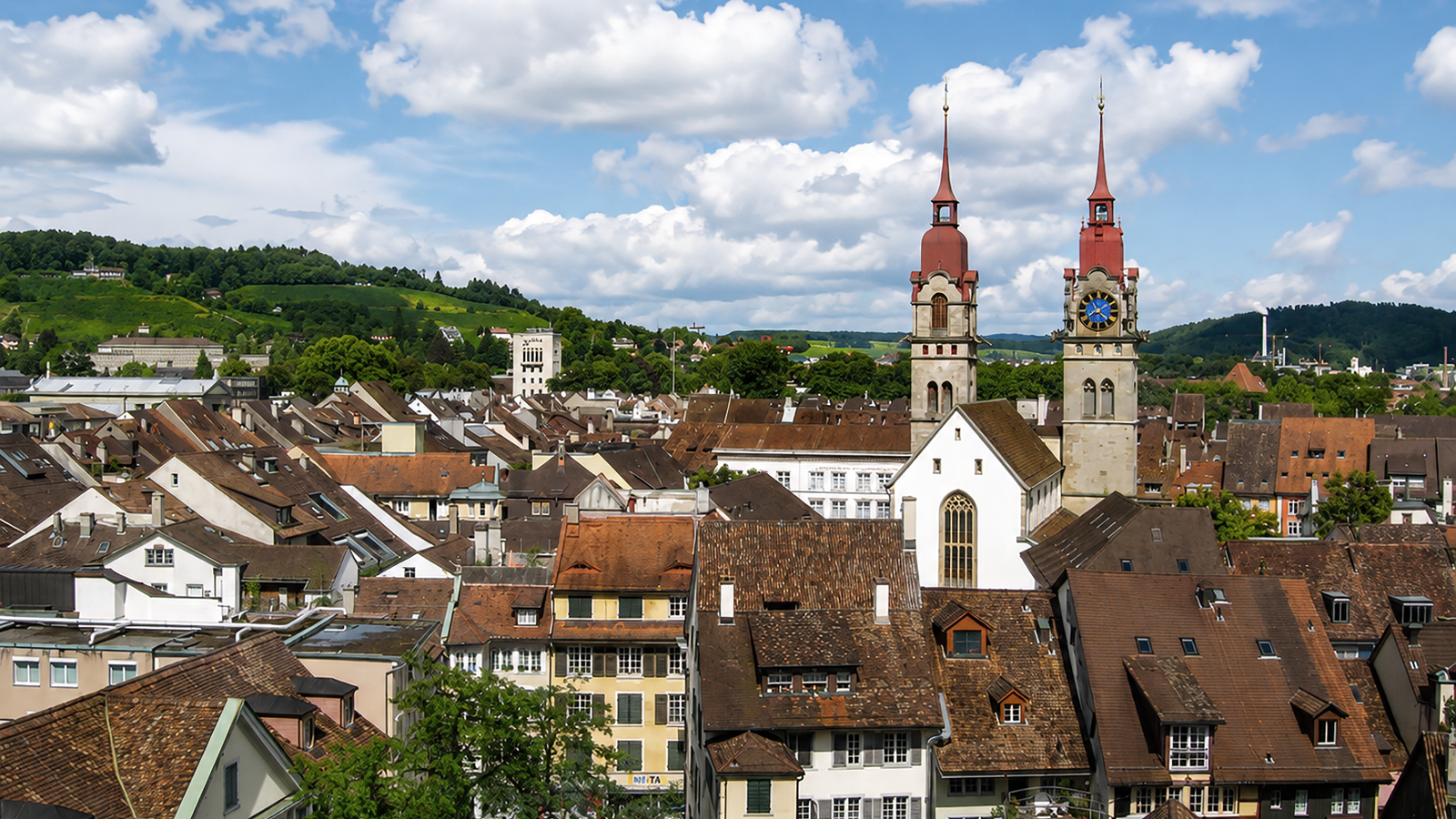
Winterthur has 120,376 residents (as of 31 December 2024), which makes it the sixth-largest city in Switzerland and the second-largest in the canton of Zurich. If you only know the name from the weather forecast, you are missing a few things: an old town entirely closed to cars, a factory site where a new district is going up, four live music clubs that have shared the calendar for more than twenty years, and a tower block that was the tallest building in the country between 1966 and 1978. This page sets out what actually happens in Winterthur, with addresses, prices and opening hours.
Getting there: station, bus terminal, bike city
About 121,000 rail passengers pass through Winterthur station every day, which puts it sixth in Switzerland behind Zurich HB, Bern, Geneva, Lucerne and Basel SBB. Trains reach Zurich Airport in Kloten in 13 to 17 minutes. The bus terminal next door is the largest in the canton of Zurich and one of the largest in the country after Sion, Lucerne and Bern; eight night bus lines leave from here on Friday and Saturday nights. Cyclists have 175 kilometres of bike routes inside the city limits, which earned Winterthur the Prix Velo in 2005. The old town itself is the largest continuous pedestrian zone in Switzerland.
The old town: Steinberggasse, Neumarkt and two markets
On Tuesdays and Fridays, from 6am to 11am, the Steinberggasse and the Metzggasse turn into the weekly market: vegetables, wholemeal bread, cheese, fish, flowers and herbs sold by the people who grew or made them. From mid-March to the end of November, a Saturday market is added at the Obertor, 9am to 2pm. In December the Neumarkt takes over. The Christmas market in the car-free old town runs for the 29th time in 2026, from 26 November to 23 December, daily from 11am into the evening, with a different supporting programme each day and a free Chlaus procession.
From a Kyburg town to an industrial city
Rudolf of Habsburg granted Winterthur its city charter on 22 June 1264, after the counts of Kyburg, who had actually founded the town, died out; the Kyburg coat of arms with its two red lions is still the city's. In the 19th century, companies such as Sulzer, the Swiss Locomotive and Machine Works (SLM) and Rieter pushed the population from 3,000 to 20,000 within a few decades. In 1922 the five municipalities of Töss, Wülflingen, Veltheim, Seen and Oberwinterthur, independent until then, were incorporated, taking the city past 50,000 people. The Sulzer high-rise, finished in 1966, was at 92.4 metres the tallest building in Switzerland until 1978; an added storey in 2007 brought it to 99.7 metres, and it still shapes the skyline together with the Roter Turm of 1999.
A city of museums: Technorama, art and photography
The large private art collections of the early 20th century gave Winterthur its reputation as a museum city, and it now counts 16 of them. The biggest draw is the Technorama at Technoramastrasse 1, where several hundred hands-on stations cover mechanics, electricity and optics, plus an outdoor park with the 130-metre Wunderbrücke that is open from April to October. The science centre opens daily from 10am to 5pm; admission is 34 francs for adults and 21 francs for children aged 6 to 15, with younger children free. For more than one museum in a day or a weekend there is a museum pass, which also covers the Kunst Museum Winterthur at its three sites (Reinhart am Stadtgarten, Beim Stadthaus and Villa Flora) and the Fotomuseum Winterthur together with the Fotostiftung Schweiz.
Forest, wildlife and water: the Eschenberg and the Töss
Woodland covers 40.6 percent of the city area, more than in any other Swiss city. Most of it is the Eschenberg south of the old town, with an observatory and the Bruderhaus wildlife park on its clearings. The park, founded in 1890, keeps wolves, lynx, mouflon and wild boar on six hectares, species native to the region now or in the past; entry is free and the gates never close. The city suggests walking or cycling there, or taking bus 4 to the Breite stop and then 30 minutes on foot through the wood. For swimming, many head to the Töss: in the Wülflinger Hard, where the Spinnerei Hard became the first mechanised factory in Switzerland in 1802, the river cuts small waterfalls into the sandstone molasse. Locals call the spot the Affenschlucht and use it for paddling, swimming and jumping in. There is also a purpose-built access to the water on the Eulach, in the Eulachpark in the Neuhegi district.
Music since 1629, and four clubs that split the calendar
The Musikkollegium Winterthur, founded in 1629, is the oldest musical body in the city and still puts on 50 to 60 concerts a year. Four clubs handle live music in the evening; they joined forces in 2004 in an association called OnThur. The Albani on the Steinberggasse has been running since 1988 and has its own nine-room hotel, with a programme of indie rock, hip-hop and blues. The Gaswerk in Töss combines a concert hall, studios and the Nische arthouse cinema. The Kraftfeld sits in building 161 on the former Sulzer site, has been open since 1996 and commits itself to at least 120 concerts a year. The Salzhaus, near the main station, leans towards acid jazz, funk and club nights. For anyone who prefers a seat and a punchline, the Casinotheater on Stadthausstrasse has staged around 250 shows a year since 2002, between comedy, cabaret, poetry slam and music, with its own restaurant, the Fredi.
Football at the Schützenwiese
FC Winterthur was founded in 1896 by students at the local engineering school and has played on the Schützenwiese in the Deutweg district ever since. The official capacity is 8,700: roughly 1,100 covered and 800 uncovered seats, plus 3,100 covered and 3,600 uncovered standing places. After promotion in 2022 the club spent four seasons in the Super League and went back down to the Challenge League at the bottom of the table after the 2025/26 season.
From the Sulzer works to the Lokstadt district
Locomotives and machines were built here until the 1980s. Since 2017 the newest part of the former Sulzer site has been going up under the name Lokstadt. Up to 1,500 people are meant to live and work there once it is finished, with about 750 flats planned and 30 percent of them affordable. The centrepiece is the Dialogplatz, opened in 2021, with more than 6,000 square metres and 150 trees; the ground floors around the square are reserved for shops, restaurants and other public-facing uses, and the area stays largely free of cars. A few minutes' walk away is the Lagerplatz, the busiest part of the older Sulzer site, where workshops, artists and the architecture department of the ZHAW have moved into the old halls, with the Kraftfeld and its Portier bistro in between.
The calendar: weekly market, Albanifest, Christmas market
The biggest event of the year is the Albanifest, which marks the city charter of 22 June 1264 and has turned the old town into a fairground for three days on the last June weekend since 1971, with more than 70 local clubs running food and drink stands and a full funfair with a Ferris wheel; the next edition runs from 25 to 27 June 2027. On weekdays the Steinberggasse belongs to the market traders, and on the Advent Sundays to the Christmas market on the Neumarkt, which fills the old town with stalls and lights until just before Christmas.
Frequently asked questions
When is the weekly market in Winterthur?
Tuesdays and Fridays from 6am to 11am in the Steinberggasse and the Metzggasse in the old town. From mid-March to the end of November there is also a Saturday market at the Obertor, 9am to 2pm. Source: City of Winterthur
How much does admission to the Technorama cost?
34 francs for adults and 21 francs for children aged 6 to 15; children up to 5 go free. Open daily from 10am to 5pm. Source: Technorama
Is entry to the Bruderhaus wildlife park free?
Yes. The park is open around the clock and there is no admission charge. Source: City of Winterthur
When does the Albanifest take place?
Traditionally on the last weekend of June. The next edition runs from 25 to 27 June 2027. Source: Wikipedia
Where does FC Winterthur play?
At the Schützenwiese stadium in the Deutweg district, with an official capacity of 8,700. Source: Wikipedia
How long is the train ride from Winterthur station to Zurich Airport?
Between 13 and 17 minutes. Source: Wikipedia
Where can you swim outdoors in Winterthur?
In the Wülflinger Hard on the Töss, at the spot locals call the Affenschlucht, where the river drops over small waterfalls used for paddling, swimming and jumping in. Source: Wikipedia