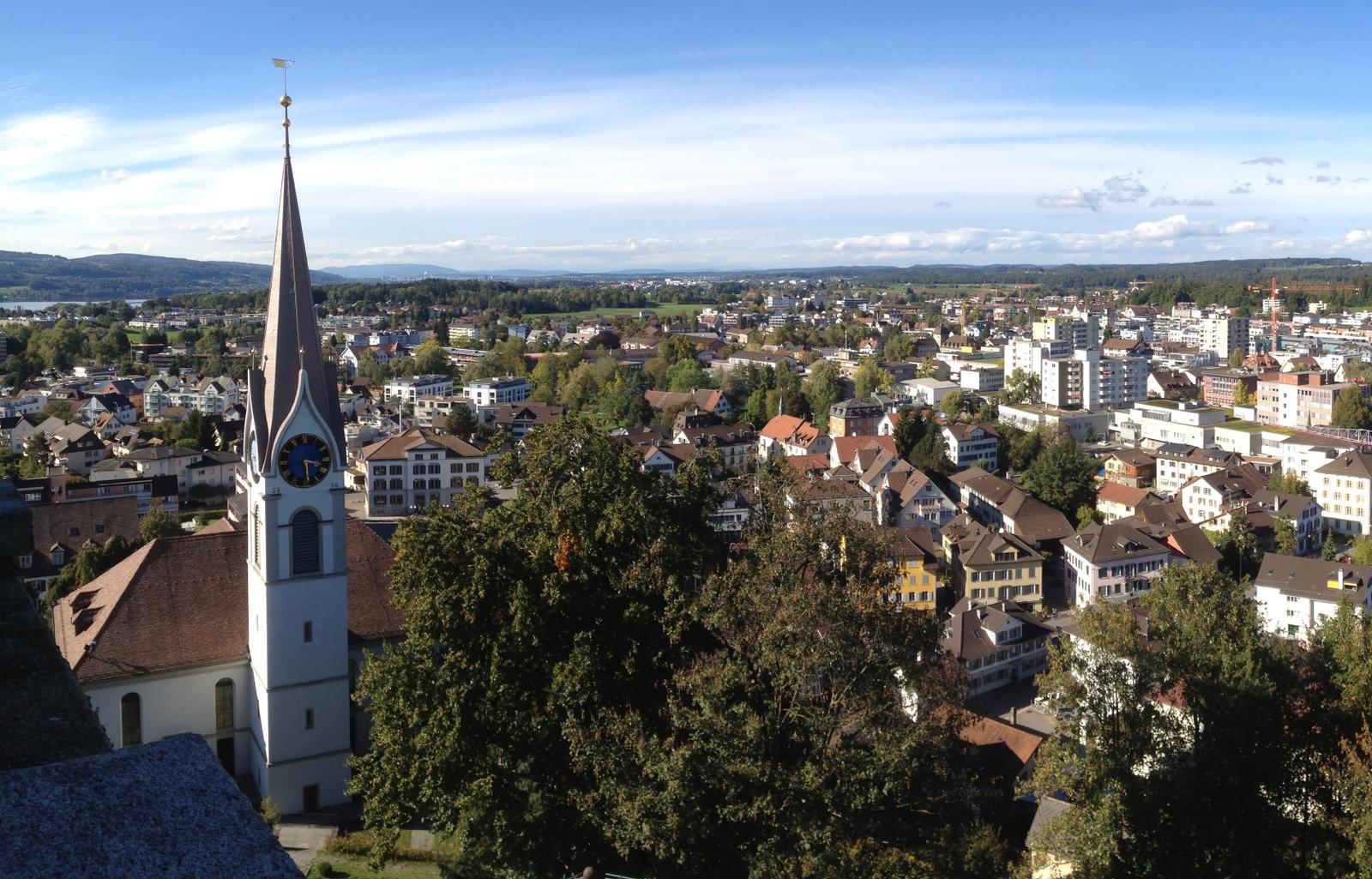
Uster sits on the eastern shore of Lake Greifen, 13 kilometres from Zurich, and counts around 37,293 residents (as of 31 October 2024), making it the third-largest city in the canton of Zurich after Zurich and Winterthur. The S-Bahn gets you to Zurich main station in 14 minutes. Despite its size, the city runs on a single traffic light: almost every junction has been replaced by a roundabout, which earned Uster the nickname 'roundabout city'. Stay longer and you find a lake with rowing, sailing and diving clubs, two outdoor pools, a contemporary art museum on the former Zellweger industrial site, Switzerland's jazz archive and, one S-Bahn stop away in Aathal, the country's largest palaeontology museum.
From weaving village to the canton's third city
Uster is first documented in 775 as Ustra villa in a St. Gallen charter. The town never formed a proper medieval core: land and castle belonged to different lords, so no old town ever grew. Uster Castle, built around 1200, still stands on the hill above Kirchuster and has housed a boarding school since 1995. On 22 November 1832, disappointed home weavers burned down the Corrodi & Pfister factory, which had been fitted with the first mechanical looms: the Usterbrand, Switzerland's best-known case of machine-breaking. Around fifty people involved were sentenced to prison terms of up to 24 years. Two years earlier, on 22 November 1830, 10,000 rural residents had gathered in Uster to demand more democratic rights, an event known as the Ustertag that led to the canton's liberal 1831 constitution. The eleven former civic communities around Kirchuster, including Nänikon, Riedikon and Wermatswil, only merged into a single municipality in 1927. In 2001, the city won the Wakker Prize from the Swiss Heritage Society for its urban planning, and in 2014 the Schulthess Garden Prize for turning the Aabach, once an industrial canal, into parkland.
Lake Greifen on the doorstep
Lake Greifen runs right along the city, with paths for cycling, inline skating and a fitness trail along the shore. Rowers train with Ruderclub Uster, which competes in the lake's annual regatta. Sailing, windsurfing, kitesurfing and diving are all possible at several spots, along with open-water swimming. The passenger boat connects Maur, Uster and back to Maur. Inside the city itself, the municipal park with its two ponds and more than seven wooded areas round out the recreation options, crossed by the Aabach, the former industrial canal the city has been renaturalising step by step since the 2000s.
Two pools, one lake
Anyone who prefers chlorine to lake water can choose between two outdoor pools. The Dorfbadi in the centre has operated since 1880, with a small pool, a paddling pool and a lawn. The Strandbad sits right on Lake Greifen with a 50-metre pool, two beach volleyball courts, a diving platform up to 5 metres and, from October to March, the 'Sauna am See' in three barrel saunas. It runs from May to September; adult entry costs CHF 6.50. Open year-round is the Buchholz indoor pool: at 6,600 square metres it is considered the largest public indoor pool in Switzerland, with a 50-metre pool, a 25-metre sports pool, a 55-metre slide and a wellness area. The rebuild cost around CHF 40 million; it reopened in December 2016.
Art in Zellweger Park
The former industrial site of Zellweger Uster AG, once nicknamed the 'forbidden city', has been a residential quarter with parkland since 2005. Freely accessible in the park are Sol LeWitt's 'Cube' (since 2011), Fischli/Weiss's 'Moosfelsen' and Tadashi Kawamata's floating footbridge 'Drift Structure'. The Bechtler Stiftung, a museum of contemporary art, opened there in 2022. At its centre stands Walter De Maria's 'The 2000 Sculpture', two thousand plaster objects laid out in a purpose-built hall, alongside Pipilotti Rist's video installation 'I Couldn't Agree With You More'. Twice a year the museum shows temporary exhibitions; past guests include Sigmar Polke and Sylvie Fleury. It is open Thursday to Sunday, 11am to 5pm.
Jazz, steam and rails
Uster's railway station is among the oldest in Switzerland: the Wallisellen-Uster line of the Glatthalbahn opened in 1856. The 1857 engine shed, with five tracks arranged around a turntable, is the oldest of its kind still standing in the country. Since 1995 it has served as a workshop for the Dampfbahn-Verein Zürcher Oberland; steam trains run between Bauma and Hinwil on the first and third Sunday of the months May to October, and the workshop itself is open on Saturdays from 9am to 4.30pm. In the same shed, the Stiftung Eisenbahn-Sammlung Uster displays historic model railway layouts. On the jazz side, Uster carries weight: the city is home to one of the country's best-known jazz clubs as well as SwissJazzOrama, Switzerland's only jazz archive, which documents more than a century of Swiss jazz history.
The trip to the dinosaurs
One S-Bahn stop from Uster, in Aathal-Seegräben, sits the Sauriermuseum Aathal, Switzerland's largest palaeontology museum. Housed since 1992 in a former spinning mill, it displays original dinosaur skeletons from the museum's own digs in Wyoming, USA, alongside a marine crocodile, a pterosaur and an amber collection. It was founded by self-taught palaeontologist Hans-Jakob Siber, who received an honorary doctorate from the University of Zurich in 2010. It is open Tuesday to Saturday from 10am to 5pm and Sunday from 10am to 6pm, closed on Mondays. Admission costs CHF 22 for adults, CHF 18 for pension and student concessions, CHF 12 for children aged 5 to 16, and CHF 60 for a family ticket. The museum has a playground with a barbecue spot and a cafeteria. By train, the S14 stops at Aathal station, about a ten-minute walk from the museum; drivers can use the free parking near the road overpass.
Clubs, judo mats and a half marathon
Uster is home to more than 71 sports clubs. Judo Club Uster, founded in 1964, ranks among Switzerland's largest judo clubs and fields a team in the top-tier Nationalliga A for both women and men. UHC Uster plays floorball, also in Nationalliga A, the country's highest division. In football, FC Uster competes in the 2. Liga interregional, while FC Rot Weiss Winikon, named after the Winikon-Gschwader district, plays in the 4. Liga. The Buchholz sports complex, next to the indoor pool, includes a sports hall, an equestrian arena, tennis, squash and badminton courts, a climbing hall, and boules and minigolf courses. Since 1980, the Greifenseelauf has taken place in mid-September, starting and finishing in Uster; since 1992 the main distance has been a half marathon, alongside shorter routes. In 1998, Uster hosted the Half Marathon World Championships.
Markets and seasons
The Uster Märt is considered the oldest market in the canton of Zurich, tracing back to a medieval livestock and goods market. It takes place on the last Thursday of November and the following Friday, with around 430 market stalls and a farm machinery market with roughly 80 exhibitors; the city centre closes to traffic on those days. Since 1997, a spring market has filled Zentralstrasse each April with around 160 stalls, and the Uster-Messe runs in autumn. Roundabouts, some carrying art installations, shape the townscape year-round, as do the ten level crossings, closed for more than 40 minutes an hour combined. The only alternative is a 3.25-metre-high underpass by the fire station, which earned the city the sarcastic 1980s slogan 'Uster, the lively town behind the barrier'.
Getting there and getting around
Four Zurich S-Bahn lines stop in Uster: the S5 towards Zug and Pfäffikon SZ, the S9 from Schaffhausen, the S14 towards Hinwil and the S15 towards Rapperswil and Niederweningen respectively. On the S5 or S15, the ride to Zurich main station takes 14 minutes, running every half hour, for eight trains an hour to Zurich. Nänikon-Greifensee station, served by the S9 and S14, adds a second stop within the municipality. Within the city, seven local and six regional bus lines round out the network. Drivers reach Uster via three exits off the Oberland motorway A53.
Frequently asked questions
What's the fastest way from Zurich to Uster?
The S5 or S15 S-Bahn connects Zurich main station to Uster in 14 minutes, running every half hour.
How much does the Sauriermuseum Aathal cost?
CHF 22 for adults, CHF 12 for children aged 5 to 16, CHF 60 for a family ticket. The museum is one S-Bahn stop from Uster, open Tuesday to Saturday 10am to 5pm and Sunday until 6pm, closed Mondays.
Can you swim in Lake Greifen at Uster?
Yes, at the Strandbad on Uferweg, right on the lake, with a 50-metre pool, a lawn and beach volleyball courts, open May to September. The Buchholz indoor pool stays open year-round.
Why is Uster called the "roundabout city"?
Because almost every junction in the city has been replaced by a roundabout. Only a single traffic light remains.
When does the Uster Märt take place?
Traditionally on the last Thursday of November and the following Friday, with around 430 stalls in the city centre.
What's on show at the Bechtler Stiftung in Zellweger Park?
At its centre, Walter De Maria's "The 2000 Sculpture", alongside Pipilotti Rist's video installation "I Couldn't Agree With You More" and temporary exhibitions. Open Thursday to Sunday, 11am to 5pm.