St. Gallen doesn't sit on a lake, it sits above one: at around 700 metres above sea level, in the hills between Lake Constance and the Alpstein range, a hermitage founded by the Irish monk Gallus grew over more than a thousand years into a city of slopes and steps, with an abbey precinct that has been a UNESCO World Heritage Site since 1983. 78,863 people live here (as of December 31, 2024), plus thousands of students at the University of St. Gallen and commuters from across eastern Switzerland every day. Walk out of the station and the cathedral is under ten minutes away; the bathing ponds above town are barely thirty.
From hermitage to free imperial city
The founding legend dates to 612: the Irish wandering monk Gallus is said to have tripped into a thicket by the Steinach river and read it as a sign to stay. The abbey's founding is historically documented for 719, by the Alemannic priest Otmar. A settlement of craftsmen and traders grew up around the monastery and became a free imperial city in the High Middle Ages, then spent centuries at odds with the Catholic prince-abbot after the city adopted the Reformation in the 16th century, since he kept residing inside the same walls. The monastery complex and its library, owned by the canton since the abbey's secularization in 1805, were named a UNESCO World Heritage Site in 1983. The city only reached its current size of almost 40 square kilometres in 1918, when it merged with the neighbouring municipalities of Straubenzell and Tablat.
The abbey precinct: library, cathedral, felt slippers
At the centre of the World Heritage site is the abbey library, one of the oldest libraries in the world, with holdings dating back to the 8th century. Because the historic wooden floor is fragile, every visitor puts felt slippers on over their shoes at the entrance. The library is open daily from 10am to 5pm, last entry 4.45pm; adult admission is 18 francs, students and pupils pay 12 francs, and the ticket also covers the vaulted cellar and the exhibition hall. Next to it stand the baroque cathedral and the monastery complex, which has served as the seat of the Diocese of St. Gallen since 1848.
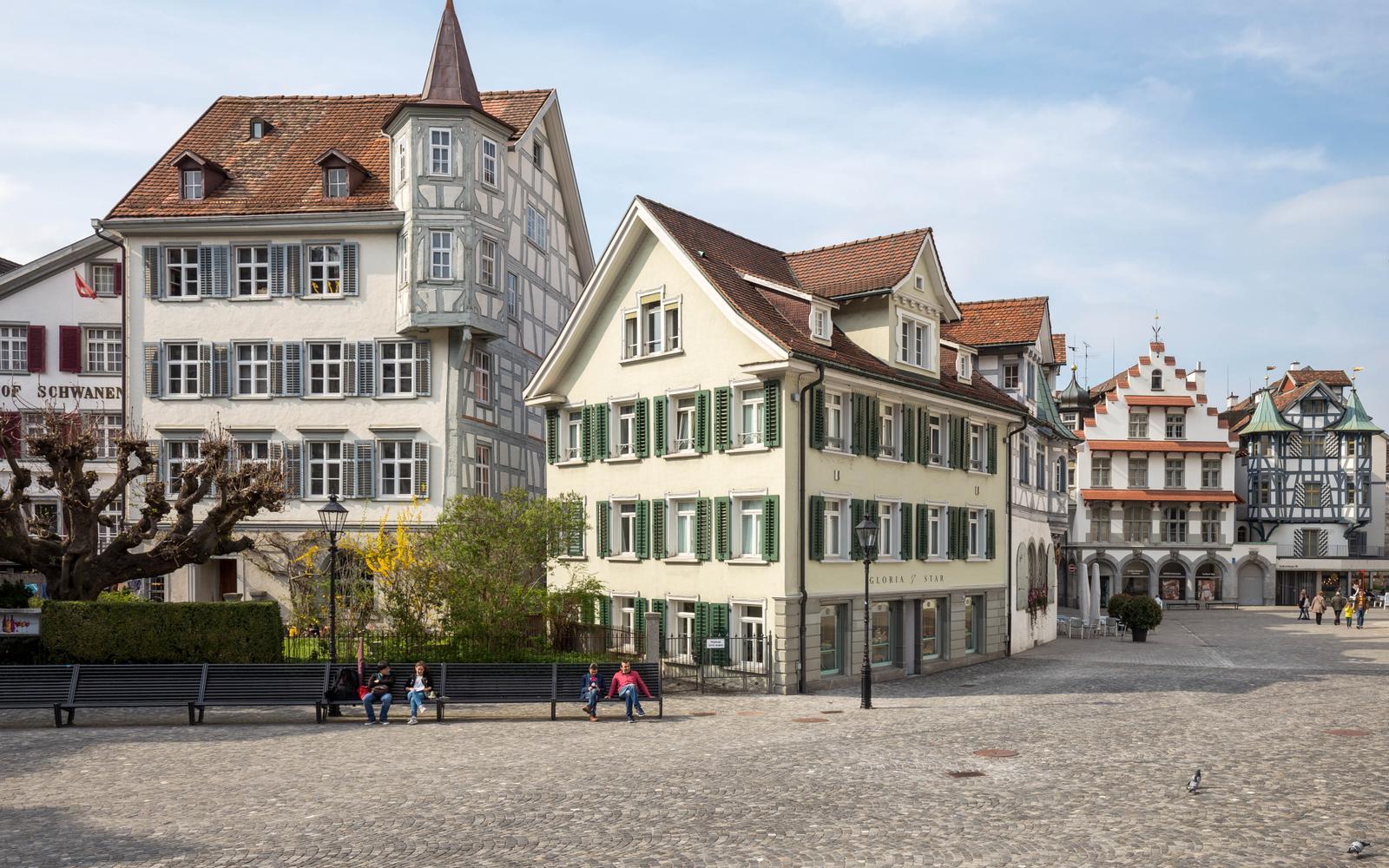
The abbey precinct borders the old town directly, recognizable by its carved wooden oriel windows, built onto houses by wealthy embroidery manufacturers and merchants between the 16th and 18th centuries. The narrow lanes around Marktplatz and Gallusplatz are pedestrian zones today, filled on weekdays with the stalls of the daily market.
Swimming above the city: the Drei Weieren
Above the old town, in the St. Georgen district, lie the Drei Weieren, known locally as the «Weiärä» or Dreilinden. These artificial ponds were dug from 1610 to supply the city and its textile bleaching works with water, later served as a fire reserve, and eventually became a recreation area. Four of the original five ponds survive today, including the Mannenweiher with the free, open-access Dreilinden community bath, and the Chrüzweiher with the Dreilinden family bath, where admission costs 5.50 CHF and which has a separate area for women. The area is served by the Mühlegg funicular, an automated, driverless cable railway that runs from Müllertor to St. Georgen every five to six minutes, plus city bus line 6 and, in summer, a free bathing bus from the station. A loop path around the ponds opens up views of the city as far as Lake Constance.
Museums: textiles, art, nature
St. Gallen's industrial history is the history of embroidery, and the Textile Museum on Vadianstrasse tells it through around 30,000 objects: fabrics from Egyptian burial finds, pattern books, and a still-functioning hand embroidery machine from 1890 that runs on Thursday and Friday afternoons. The museum is open Tuesday to Sunday, 10am to 5pm; adult admission is 12 francs, students and under-18s pay 5 francs. From June 1, 2026, the museum will be closed on Mondays.
The Kunstmuseum St. Gallen, founded in 1877, shows painting and sculpture from the late Middle Ages to the present. The neighbouring Kulturmuseum covers the region's urban, cultural, and natural history. For natural history specifically, head to the Neudorf district, where the Naturmuseum has been based since November 2016.
Concerts between the Grabenhalle and the Tonhalle
For rock, indie, and alternative shows, the Grabenhalle is the city's standing venue, a cultural hall for up to 450 people that marked 40 years in 2024. The Palace, a former cinema on Blumenbergplatz, combines concerts with discussion events. Classical music has its home at the Tonhalle, where the St. Gallen Symphony Orchestra performs under chief conductor Modestas Pitrenas, in the post since 2018, while the Theater St. Gallen also runs the St. Galler Festspiele, an open-air opera production in the abbey courtyard.
Market, Olma, and the children's festival
Around Marktplatz, stalls open Monday to Saturday, 8am to 6pm on weekdays and until 5pm on Saturdays. On Wednesdays and Saturdays, additional stalls from the weekly market join in.
The Olma, the Swiss trade fair for agriculture and food, has run every autumn since 1943 at the Olma fairgrounds, for eleven days, drawing over 300,000 visitors a year. In 2026 it runs October 8 to 18, with the canton of Schwyz as guest canton. Fixed features include the guest canton's parade through downtown, the piglet race, and the Olma bratwurst. Spring brings the OFFA, the city's second major public fair, running since 1978. Every three years, the St. Galler Kinderfest, a children's festival, moves through the streets with a parade of schoolchildren, a tradition that grew out of an earlier promotional parade for the textile industry.
FC St. Gallen and the stadium in the west
FC St. Gallen 1879 is considered the second-oldest football club still active on the European continent. It plays its home games at the stadium on the city's west side, with a capacity of 19,694, known as the Kybunpark through the 2025/26 season and as the Berit Sitterstadion from the 2026/27 season on. At 652 metres above sea level, it's the highest-altitude stadium in Swiss professional football. In the 2022/23 season, average attendance reached 17,575 per home game, with the stadium selling out repeatedly.
A university city and business hub
St. Gallen has officially held the title of university city since 1995, anchored by the University of St. Gallen (HSG), one of Europe's best-known business schools. From St. Gallen, Zurich is about an hour away, by train or by car on the A1 motorway. The city's former standing as a world centre of embroidery survives mainly in the Textile Museum and the townscape; economically, St. Gallen has become a services and insurance hub for eastern Switzerland, and has hosted the Federal Administrative Court since 2012.
Getting around and everyday transport
Since 2019, four long-distance trains an hour have connected St. Gallen to Zurich, with the fastest connection taking around 47 minutes. The station, rebuilt since 2018, is also the hub of the St. Gallen S-Bahn, running every half hour at the canton's larger stations. Trolleybuses and buses run by VBSG serve the city itself; the centre is easy to cover on foot, though the elevation changes between the station, the old town, and higher districts like St. Georgen are noticeable.
What changes with the seasons
In winter, the Drei Weieren sometimes freeze over and people skate on the ice. In summer, the Mannenweiher and the family bath become the after-work destination, while the Festspiele play outdoors in the abbey courtyard. Autumn belongs to the Olma, with its fairground rides and livestock shows at the fairgrounds, spring to the OFFA. Around Christmas, the St. Galler Weihnachtsmarkt opens in the old town. To swim in summer without crossing the whole old town, the Mühlegg funicular runs straight to the ponds; to reach the Olma in autumn, walking or taking the bus works best, since the area around the Rosenberg tunnel gets busy.
Frequently asked questions
How much does the St. Gallen abbey library cost to visit?
Adult admission is 18 francs, students and pupils pay 12 francs. The ticket also covers the vaulted cellar and the exhibition hall. The library is open daily from 10am to 5pm, last entry 4.45pm. Source
How do you get to the Drei Weieren?
By the Mühlegg funicular from Müllertor, every five to six minutes, or by city bus line 6. In summer, a free bathing bus also runs from the station. Source
When does the 2026 Olma take place?
From October 8 to 18, 2026, with the canton of Schwyz as guest canton. The fair runs eleven days. Source
Can you swim for free in St. Gallen?
Yes, the Dreilinden community bath at the Mannenweiher is open access and free. The Dreilinden family bath at the Chrüzweiher charges admission. Source
How long is the train ride from St. Gallen to Zurich?
The fastest connection takes around 47 minutes, slightly more on average. Since 2019, four long-distance trains have run every hour. Source
When is the weekly market in St. Gallen?
Stalls around Marktplatz open Monday to Saturday, 8am to 6pm on weekdays and until 5pm on Saturdays. Extra weekly-market stalls join in on Wednesdays and Saturdays. Source