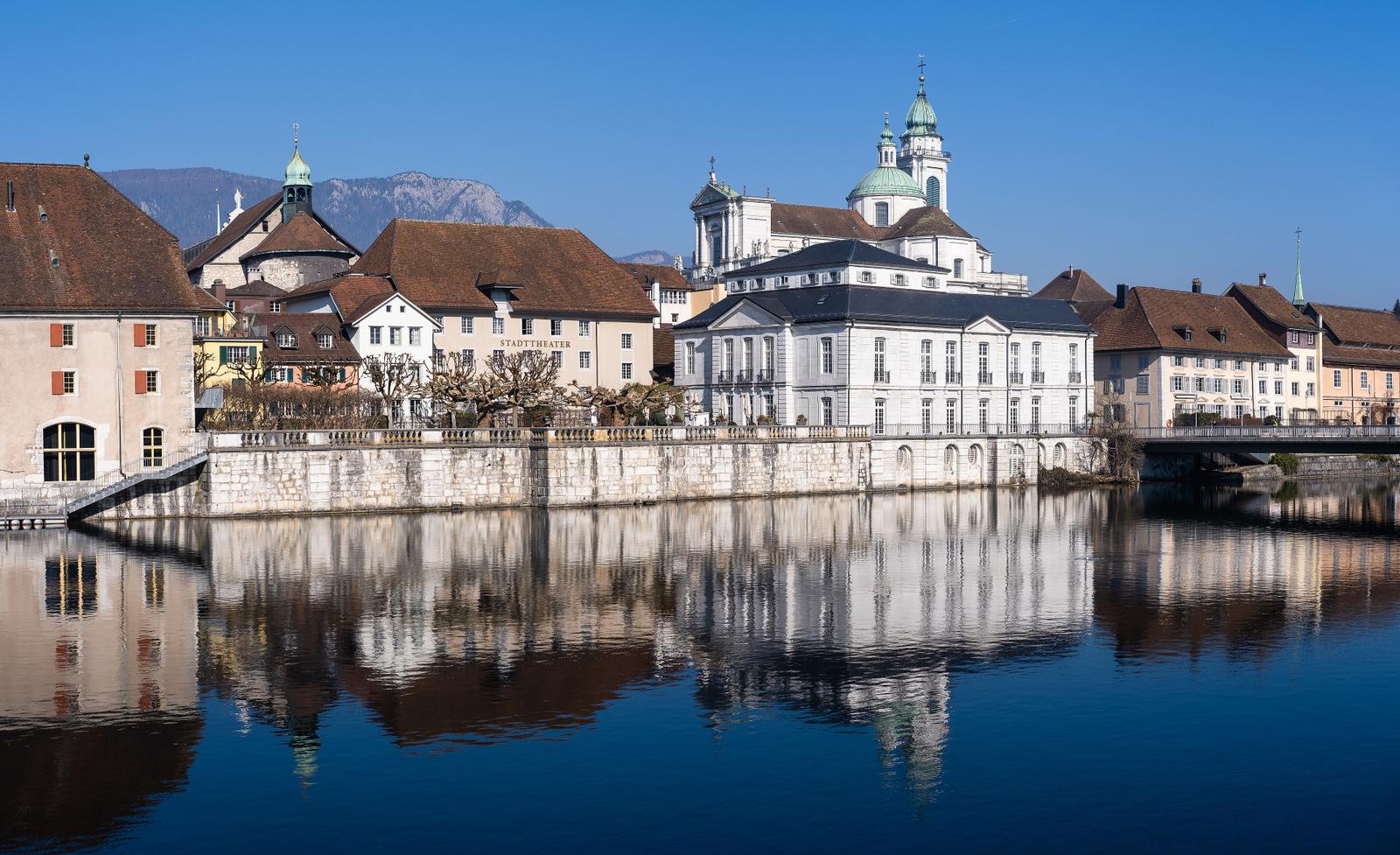
Solothurn sits on the Aare, where the Jura mountains meet the Swiss plateau, and is the capital of the canton of the same name. The city counts 16,847 residents (as of 31 December 2024) and forms its own district. Walk through the old town and the number eleven turns up everywhere: eleven churches, eleven towers, eleven fountains. That is not a marketing trick, it goes back to the Middle Ages.
History
After the extinction of the House of Zähringen, Solothurn became a free imperial city in 1218. In 1481 it joined the Swiss Confederacy together with Fribourg, under the Stans Agreement and initially with limited rights. Between 1530 and 1792 the French ambassador to the Old Swiss Confederacy resided in Solothurn, which is why the city is still nicknamed the "Ambassadors' City". The mercenary trade brought wealth into the city, visible today in the patrician houses of the old town, most of which were built between 1520 and 1790.
The old town today
St. Ursen Cathedral was built between 1762 and 1773 according to plans by the Ticino architect Gaetano Matteo Pisoni and is considered the most significant Swiss building of the Early Classical period. 249 steps lead to the observation deck at a height of 50 meters, which is accessible from April 1 through October 31. The number eleven is a recurring theme throughout the building: eleven altars, eleven bells, and an outdoor staircase consisting of three sets of eleven steps.
The city’s oldest building is the clock tower on the market square, erected at the beginning of the 13th century. Its astronomical clock mechanism dates from 1545 and was built by Lorenz Liechti and Joachim Habrecht. The cobblestone-paved Old Town is car-free.
Culture and museums
For a city of its size, Solothurn has a surprisingly rich museum scene. The Solothurn Art Museum opened in 1902 and features the Solothurn Madonna by Hans Holbein the Younger, painted in 1522, as well as works by Cézanne, Matisse, Klimt and Ferdinand Hodler. The Natural History Museum is particularly family-friendly: animals, fossils and interactive exhibits offer a playful introduction to the natural history of the region, making it an ideal place to visit with children. The Old Arsenal Museum offers a completely different experience, with its impressive collection of historical weapons, armour and military equipment.
Once a year, during the last week of January, the Solothurn Film Festival transforms the city into a centre of Swiss cinema. Founded in 1966, the festival now attracts more than 65,000 admissions per edition.
Practicalities
Solothurn railway station is about 600 metres from the city centre. The fastest train connection to Bern takes 35 minutes, to Basel about one hour with one change. Solothurn Tourism has its office at Hauptgasse 69. Solothurn is twinned with Heilbronn in Germany, Kraków in Poland, and the Neuchâtel municipality of Le Landeron.
Frequently asked questions
How many people live in Solothurn?
As of 31 December 2024, the city of Solothurn had 16,847 residents. Source: Wikipedia.
Why is the number eleven everywhere in Solothurn?
The number eleven has been celebrated since the Middle Ages: eleven churches, eleven fountains, eleven towers. St. Ursus Cathedral follows the same pattern with eleven altars, eleven bells and an outdoor staircase of three flights of eleven steps.
How long is the train ride from Solothurn to Bern?
The fastest direct train to Bern takes 35 minutes.
When can the tower of St. Ursus Cathedral be climbed?
The tower is open from 1 April to 31 October. 249 steps lead to the platform at 50 metres.
Where does the nickname 'Ambassadors' City' come from?
Between 1530 and 1792 the French ambassador to the Old Swiss Confederacy resided in Solothurn.
When does the Solothurn Film Festival take place?
The festival takes place every year in the last week of January. It was founded in 1966 and draws over 65,000 admissions per edition.
Is Solothurn's old town car free?
Yes, the cobbled old town is closed to car traffic.