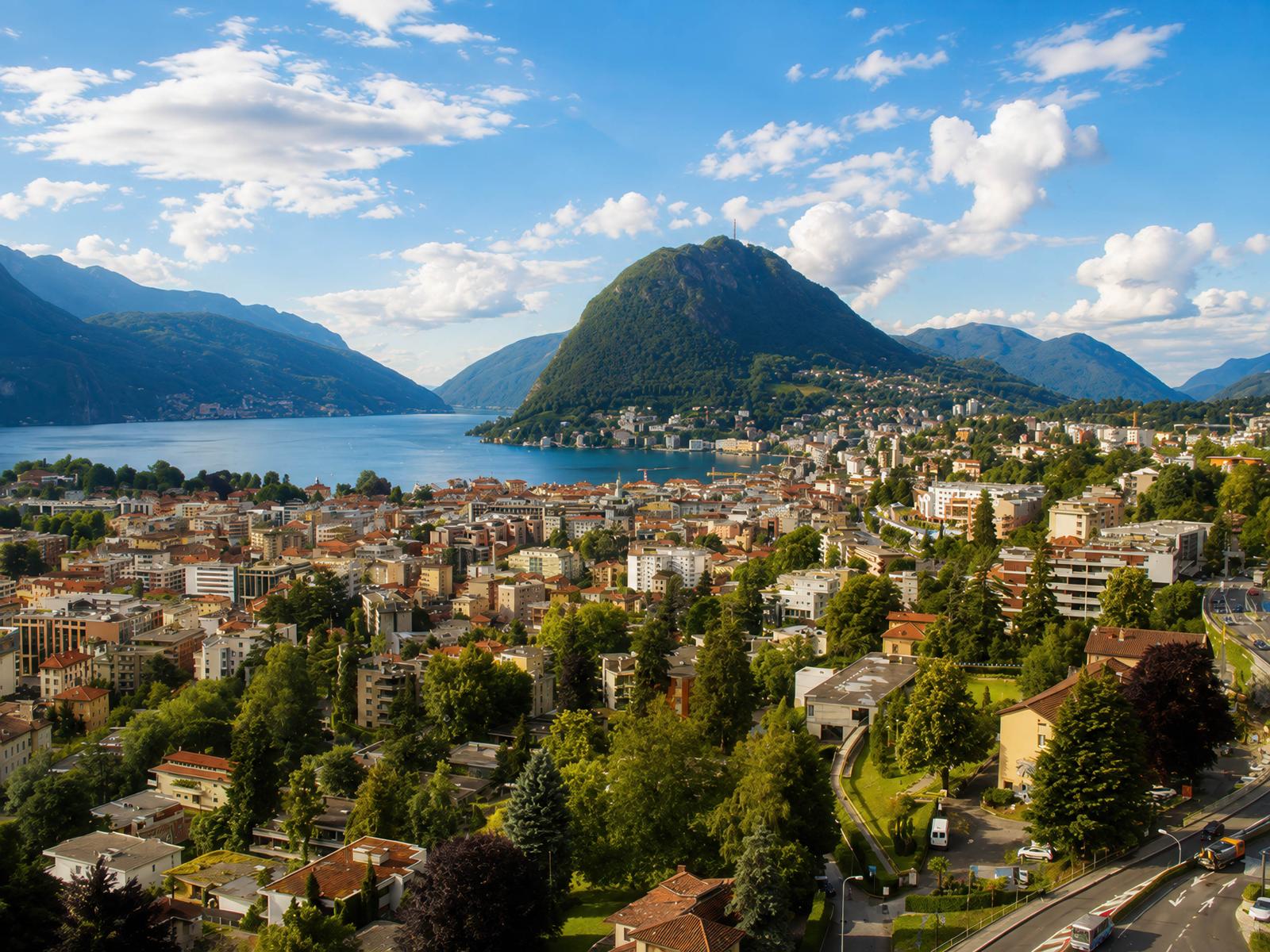
Lugano sits on the northern shore of Lake Lugano, in the Sottoceneri region of Ticino, at 273 metres above sea level. With 68,633 residents from 141 countries, it is Switzerland's ninth-largest city and the biggest Italian-speaking municipality outside Italy. Behind Zurich and Geneva, Lugano ranks as the country's third-largest financial centre. It's also the warmest station in the MeteoSwiss network. First-time visitors find an arcaded old town with a market that fills the lanes twice a week, two local mountains served by historic funiculars and a lake that invites swimming in summer.
History: from bailiwick to banking city
The name Lugano first appears in documents in 1189, as Luanasco, Luano or Lugano. Between 1789 and 1803 Lugano was capital of the Helvetic canton of the same name, and from 1814 to 1878 the city held the seat of the Ticino cantonal government on a six-year rotation with Bellinzona and Locarno. The city's current extent is recent: Castagnola and Brè-Aldesago joined in 1972, followed in 2004 by Breganzona, Gandria and Viganello among others, in 2008 by Barbengo, Carabbia and Villa Luganese, and finally in 2013 by Cadro, Carona, Sonvico and further municipalities. These four waves of mergers created the "Grande Lugano", now made up of 21 districts with more than double the population it had before the first merger. Proximity to Italy and the former banking secrecy laws made Lugano, over the 20th century, Switzerland's third-largest financial centre, after Zurich and Geneva.
Old town: arcades, market and the Maghetti quarter
The historic centre is built around Piazza della Riforma, the old town's largest square, home to the town hall. Narrow arcaded lanes link the square to the lakeside promenade. On Tuesdays and Fridays, from 7:30 am to 2:30 pm, the triangle between Via Carducci, Piazza San Rocco and Via Canova turns into a food and flower market: small farms from the region sell what they produce directly, from eggs to cheese and cured meats to fruit and vegetables. On Saturdays an antiques and crafts market moves into the nearby Maghetti quarter. The quarter itself was rebuilt from scratch in 1984, after an oratory opened in 1902 was demolished, and now has inner courtyards, shops, boutiques, bars and restaurants. It's also home to Cinema Iride, one of the city's historic cinemas.
Getting there and around
Lugano lies on the Gotthard axis. From Zurich, the fastest trains take 1 hour 53 minutes to cover roughly 156 kilometres, running several times a day with no change of train. Within the city, the Lugano-Bahnhof SBB funicular, opened in 1886, links the old town to the railway station; since 2016 it has also carried the name "Sassellina".
Water and nature: the lake, the Lido and Parco Ciani
Lake Lugano sits at 271 metres above sea level, while the city's own territory runs from 273 metres at the shore up to 2,116 metres at the summit of Monte Gazzirola. On the eastern shore, reachable on foot along the lakeside promenade, is the Lido di Lugano: a sandy beach with lake access, a heated Olympic pool, a diving pool with platforms up to ten metres high, and a beach volleyball court. The lido is open seasonally from May to September, with admission running between 6 and 14 francs depending on age and time of day; children under six get in free. For something quieter, there's Parco Ciani: a 63,000-square-metre park on the lakeshore, laid out from 1845 by the Milanese businessmen Filippo and Giacomo Ciani and owned by the city since 1912. From March to October the park is open from 6 am to 11:30 pm, and from November to February from 6 am to 9 pm.
Mountains above the city: Monte Brè and Monte San Salvatore
Two funiculars connect Lugano to its local mountains. The Monte Brè line has run since 1908, climbing 629 metres over a 1,599-metre track and taking under ten minutes to reach the summit at 933 metres. The second funicular runs from Lugano-Paradiso up Monte San Salvatore, which stands 912 metres high. The route is 1,660 metres long, split into two sections, and reaches a maximum gradient of 61 percent; passengers change at the Pazzallo mid-station, and the whole ride takes around twelve minutes. A one-way trip costs 25 francs, a return 32 francs for adults, while a return with a half-fare card or a general travelcard costs just 16 francs.
Art and culture: the LAC, the MASI and a fresco by Luini
The LAC Lugano Arte e Cultura cultural centre, on Piazza Bernardino Luini, houses the Museo d'arte della Svizzera italiana (MASI), formed by merging the cantonal and municipal art museums. It's open Tuesday, Wednesday and Friday from 11 am to 6 pm, Thursday until 8 pm, and weekends and public holidays from 10 am to 6 pm; closed Mondays. Admission costs 20 francs, 16 francs reduced, and entry is free from 6 to 8 pm on the first Thursday of the month. Anyone interested in older art can head to the church of Santa Maria degli Angioli on the lakeside promenade: the fresco of the Passion and Crucifixion of Christ, completed in 1529 by Bernardino Luini, a pupil of Leonardo da Vinci, shows over 150 figures on a single wall and is considered Switzerland's best-known Renaissance fresco. The same church holds two further works by Luini, a Last Supper and a Madonna and Child.
Sport in the Cornaredo district
The Cornaredo district is the city's sporting hub. FC Lugano, founded in 1908, plays its home games at Stadio di Cornaredo, which opened in 1951 and now holds 6,330 seats. In 1954 the stadium hosted a match of the football World Cup.
After hours
In the evening, life shifts outdoors. Bars and terraces fill up around the Maghetti quarter, Piazza della Riforma and the lanes between them. In summer, many head on toward the lake and the Foce for an aperitivo, a late dinner or a long evening out.
Families and seasons
Parco Ciani offers 63,000 square metres of space for walks and picnics year round, right in the city centre. The climate sets it apart from the rest of Switzerland: with an average annual temperature of 13.0 degrees, Lugano is the warmest station in the MeteoSwiss network, and the city averages more than 2,000 hours of sunshine a year.
Frequently asked questions
How long does the train journey from Zurich to Lugano take?
With the fastest connection, 1 hour 53 minutes for around 156 kilometres, several times a day with no change of train. Source
How much does entry to the Lido di Lugano cost?
Between 6 and 14 francs depending on age and time of day, with children under six admitted free. The lido is open from May to September. Source
When is the weekly market in Lugano held?
Tuesdays and Fridays from 7:30 am to 2:30 pm, between Via Carducci, Piazza San Rocco and Via Canova. On Saturdays an antiques and crafts market follows in the Maghetti quarter. Source
How do I get up Monte Brè?
By funicular from Cassarate or Ruvigliana. The ride takes under ten minutes to the summit, at 933 metres. Source
What does the fresco in the church of Santa Maria degli Angioli show?
A work by Bernardino Luini completed in 1529, depicting the Passion and Crucifixion of Christ, with over 150 figures on a single wall. Source
What language is spoken in Lugano?
Italian, the sole official language of the canton of Ticino. Source
When is the MASI at the LAC open?
Tuesday, Wednesday and Friday 11 am to 6 pm, Thursday until 8 pm, weekends and public holidays 10 am to 6 pm, closed Mondays. Source