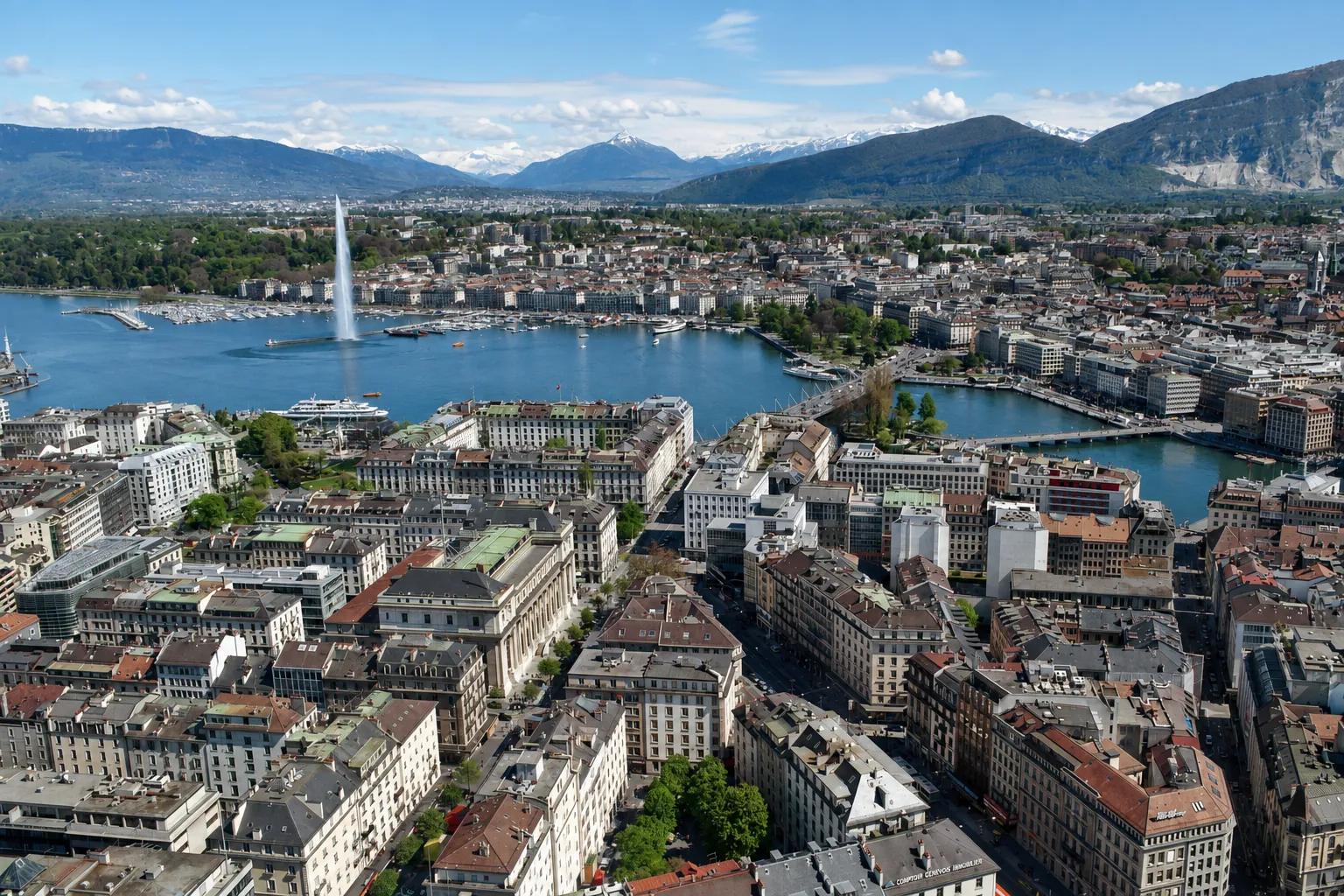
Geneva sits at the south-western end of Lake Geneva, where the Rhône flows out of it. 206,635 people live on 15.89 square kilometres, which works out at 13,004 residents per square kilometre, the highest density of any Swiss municipality. 50.1 per cent of them hold no Swiss passport (as of 31 December 2023), a level matched in Switzerland only by Basel and Lausanne. The official language is French. Geneva is the capital of the canton of the same name and the second largest city in the country after Zurich.
From bishop's seat to the 22nd canton
Caesar records the place in 58 BC as Genava. From 400 to 1536 Geneva was a bishop's seat, and from 1026 it belonged to the Burgundian part of the Holy Roman Empire. In 1536, following the preaching of Guillaume Farel, the city adopted the Reformation and proclaimed the Republic of Geneva. In 1559 John Calvin founded the Geneva Academy, out of which the University of Geneva grew. On a December night in 1602 the Savoyard assault on the city walls failed. It is still marked every year on 12 December as the Escalade.
France annexed Geneva in 1798 and made it the capital of the Département du Léman. On 31 December 1813 Austrian troops occupied the city, after which Geneva asked to join the Confederation. On 12 September 1814 the Federal Diet confirmed its entry as the 22nd canton; the treaty of union was signed on 19 May 1815.
The Monument national stands in the Jardin anglais, at the foot of the Mont-Blanc bridge. Robert Dorer designed the bronze group, which was inaugurated in 1869. It marks Geneva's entry into the Confederation on 12 September 1814, commemorated at the Fêtes de Septembre of 1864 and 1869. The same park has held the flower clock since 1955.
Cathédrale Saint-Pierre and the old town
Work on the cathedral began in 1160 and continued for about a century. Fires and rebuilding have layered Romanesque, Gothic and neoclassical elements on top of each other; the present facade dates from the mid-18th century. The Reformation stripped the painted interior decoration, and only the windows survived. 157 steps lead up the north tower, where the largest of the bells was hoisted in 1407. Beneath the cathedral, an archaeological site holds finds from prehistory to the Middle Ages.
The nave is free to enter. Climbing the towers costs 7 francs. Tower access closes 30 minutes before the building. Current times are on the City of Geneva website.
The international city
Geneva hosts 34 international organisations, among them the UN, WHO, ICRC, WTO, WIPO and the International Telecommunication Union, ITU. 175 states are represented in the city, which counts 256 permanent missions, representations and delegations in total. More than 28,000 people work directly for international organisations and accredited missions; their share of the canton's economic output is 9.2 per cent. Some states keep their diplomatic representation to Switzerland here rather than in Bern.
The ITU goes back to the International Telegraph Union, founded on 17 May 1865 in Paris. It has been a specialised agency of the United Nations with its seat in Geneva since 1947 and today has 193 member states.
The first Pont du Mont-Blanc, made of sheet metal, was built in 1862. After the tram was laid in 1883 the roadway had deteriorated so badly that the frame and deck had to be rebuilt entirely. The present bridge dates from 1903, measures 252 metres and rests on seven main girders. The concrete deck is 19 metres wide and was widened by 6 metres in 1967. The bridge, street and quay take their name from the massif visible from here in clear weather.
Shopping on the Rue de Rive
In March 2026 the city parliament approved a credit of 44.6 million francs to turn the area around the Rond-point de Rive into a pedestrian zone. The plans include 132 additional trees on the Rue Pierre-Fatio and the removal of 99 car parking spaces and 255 spaces for motorised two-wheelers. The tram is to run on its own track. Construction is scheduled to take five years, so anyone visiting during that period will run into building sites. An earlier project with an underground car park was rejected at the ballot box in March 2021.
Practical: getting there and getting around
Genève-Cornavin station is the long-distance hub. Six long-distance trains an hour run between Geneva and Lausanne. Since 15 December 2019 the Léman Express has linked the Swiss and French networks via Genève-Eaux-Vives as far as Annemasse. Within the city, Transports publics genevois run four tram lines and six trolleybus lines alongside bus routes. Geneva airport lies in the suburb of Cointrin and is the country's second largest.
Geneva ranks among the cities with the highest cost of living worldwide. Traffic routes in the city are heavily loaded; mobility and the housing shortage are permanent political topics.
The Jet d'eau: 140 metres from a pressure relief valve
The Jet d'eau pushes out 500 litres of water per second at 200 km/h and reaches 140 metres. It started in 1886 as a pressure relief valve on the hydraulic main that drove the machines in Geneva's workshops: when the workshops closed in the evening, the pressure had to go somewhere. In 1891 the city moved the fountain into the harbour basin. The current installation dates from 1951, and filtered lake water has been used instead of drinking water ever since. Since 2003 it has run all year during the day, except in frost or strong wind. Walk out along the jetty and a shift in the wind will soak you.
Frequently asked questions
How many people live in Geneva?
206,635 residents as of 31 December 2023, on a municipal area of 15.89 square kilometres. That makes Geneva the second largest city in Switzerland after Zurich and the most densely populated municipality in the country. Source: Wikipedia.
What does climbing the towers of Cathédrale Saint-Pierre cost?
The nave is free. Climbing the 157 steps costs 7 francs. Tower access closes 30 minutes before the building. Current times and prices: geneve.ch.
Does the Jet d'eau run all year?
Since 2003 the fountain has run all year during the day, except in frost or strong wind. Between spring and autumn it is lit in the evenings. Anyone walking out along the jetty should expect to get wet if the wind turns.
Do I need a ticket for buses and trams in Geneva?
Anyone staying overnight in Geneva receives the Geneva Transport Card free and travels with it in unireso zone 10 on TPG buses and trams, SBB trains and the Mouettes genevoises. Everyone else buys a single ticket from the machines at every stop, valid for one hour, or a day ticket. Nothing needs validating, but keep the ticket. Details: tpg.ch.
Why are so many international organisations based in Geneva?
The foundations were laid in the 19th century: in 1864 Geneva became the seat of the International Committee of the Red Cross, and from 1920 to 1946 the League of Nations sat here in the Palais Wilson. Today the city hosts 34 international organisations and 175 states are represented. Along with New York, Geneva is one of the few cities hosting major international organisations without being a national capital.
What is the Escalade about?
The failed Savoyard assault on Geneva's city walls on a December night in 1602. It is marked every year on 12 December, with the marmites d'Escalade, chocolate cauldrons filled with marzipan. In 1603 Savoy recognised Geneva's independence in the Treaty of Saint-Julien.
When did Geneva become part of Switzerland?
Since 12 September 1814: on that day the Federal Diet confirmed Geneva's admission as the 22nd canton. The treaty of union was signed on 19 May 1815. Before that, Geneva had been annexed by France from 1798 and served as capital of the Département du Léman. The Monument national in the Jardin anglais recalls it.